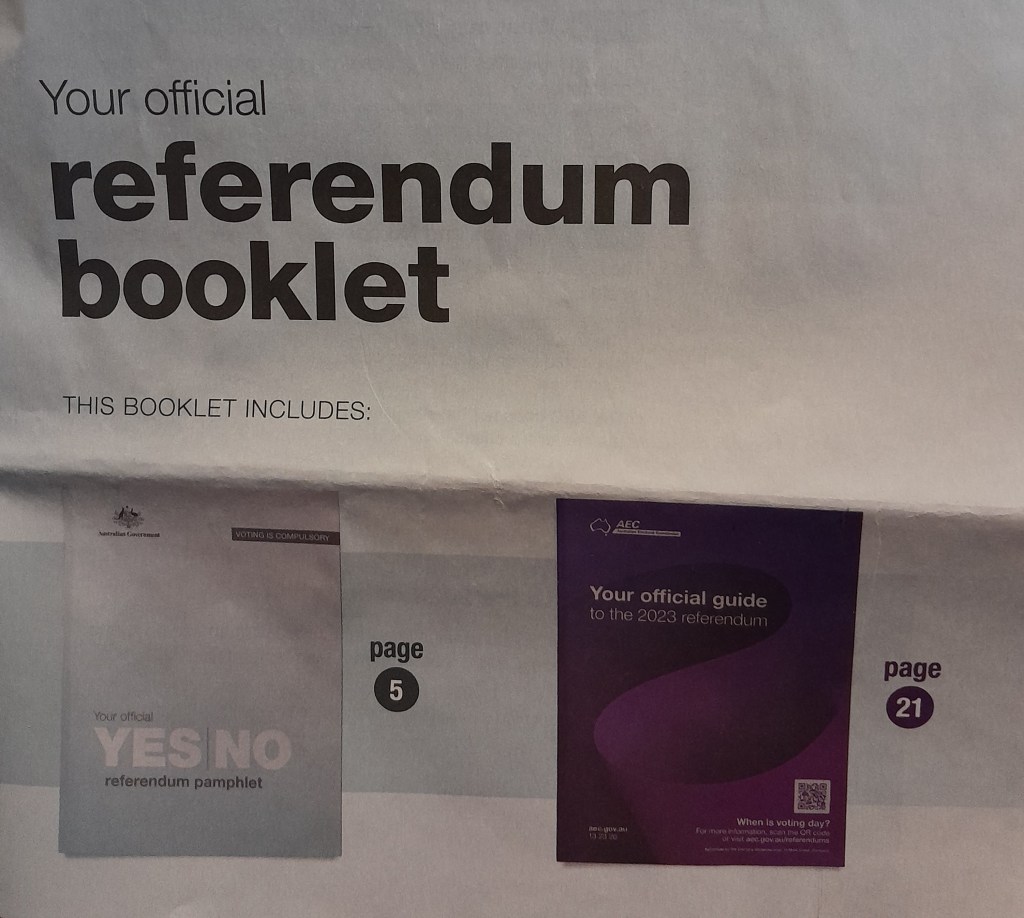
First Nations people will be targets of colonial violence when Australians vote on October 14, as they have been on every October 14 since British invasion. In the past, this violence took the form of the genocidal massacres of the frontier wars. Today, it manifests itself in different ways – through mass incarceration, child-theft, and deaths in custody; through the destruction of cultural heritage and the enclosure and ecocide of traditional lands; through planned negligence in health, housing and education. To end these crimes, urgent and radical political change is needed.
Instead, we’re getting the Voice to Parliament referendum. The referendum, which seeks to realise one part of the Uluru statement, perfectly crystallizes the blockages over Indigenous justice in Australia. On one side, the mainstream ‘No’ campaign has harnessed unhinged settler paranoia about Indigenous revenge. Their fantasies that even the meanest gesture towards justice will see native title claims mushrooming over suburban Australia are ludicrous and contemptible, but they hit their mark. On the other side, the Yes campaign offers the shockingly modest proposition that ‘the simple act of asking the Parliament to listen’ itself constitutes an improvement in Aboriginal and Torres Strait Islander lives.
Where ‘no’ is spearheaded by virulent racists – sometimes supported by explicit fascists – the Uluru-derived ‘yes’ case has been taken up by the very mainstream political and economic forces who bear significant responsibility for the ongoing oppression of Indigenous people. For major corporations like Rio Tinto, Qantas, Coles and Woolworths, as well as for the ALP, the main driver of support for the Voice was clearly the assessment that it would slap a shiny veneer of feel-good progressivism over their public images, all of which are, for similar reasons, sorely in need of rehabilitation. Even better, this positive publicity would come for free: the profitable business-as-usual of Australian capitalism (including the harms it intrinsically causes to Indigenous people) would run on unobstructed.
According to one pollster, the support of Coles, Woolworths and Qantas for yes has ended up fuelling the no case: for a public under severe cost-of-living pressures, profiteering ASX100 companies have low political and moral credibility, so their support for yes is positively damaging. Could there be any better indication of the inability of sclerotic Australian capitalism to deliver change?
Supporting the Voice should mean more than just supporting the Voice
When Aboriginal people call for the Voice, they do so as a subaltern population subject to generations-long racist violence. You’ve dispossessed and killed us for more than two centuries, they’re saying; now, if you really want to stop, at least listen to us about what needs to change. The modesty of this request is breath-taking. For anyone who cares about righting wrongs against Indigenous people, just agreeing to it cannot possibly be enough: there’s a form of violence involved in agreeing to a request that is so limited, so minimal, without also immediately committing to more substantial measures as well. To adequately respond to the claim for justice implicit in the request for the Voice, it would actually be necessary to exceed the demand it makes, and to do so radically.
This is exactly what the whole politics of the yes campaign precludes. The mainstream yes case rests on assurances that the areas over which the Voice will advise – housing, employment, education and health – are highly circumscribed, and that even on these it won’t be able to mandate the spending of a single dollar. Stronger demands – even just implementing the 30-year old recommendations of the deaths in custody royal commission, or the symbolic shifting of Australia Day (now even supported by no campaigner Warren Mundine) – have been excluded. Even on the issues within its remit, the government and other yes supporters have made it quite clear that recommendations of the Voice won’t necessarily be accepted. To that extent, the Voice will not give Aboriginal and Torres Strait Islander people the actual ‘power over [their] destiny’ to which the Uluru statement aspired. This is, of course, the substance of the progressive no case.
Ignoring Aboriginal people’s recommendations is in the DNA of Australian politics. If the Voice is established, politicians will be able to continue making policy that harms Aboriginal people, but now with the cover of having ‘listened’ to constitutionally-mandated Indigenous advice. This possibility is very real, and dangerous, and it exists regardless of the strength and political talent of the First Nations members of the Voice. It will be even more likely if – the best-case scenario, to judge from current polls – the Voice is only narrowly voted up.
Knowing what Indigenous people think
Yes campaigners regularly remind us that the impetus for the Voice came from Aboriginal people through the Uluru statement, and that polls tell us that an overwhelming number of Aboriginal people – over eighty percent – are voting yes. The mere voicing of questioning perspectives on the referendum, let alone of critical ones, can sometimes be enough to provoke indignant charges – typically from people who are not Indigenous – of ignoring Aboriginal people and what they are asking.
If they were true, those charges would be serious. However, as the Black Peoples Union and others have pointed out, the question of Indigenous support for the Voice is far from being so simple (see here and here for more details). To concentrate only on the question of the polling, according to the ABC, considerable uncertainty surrounds the 80%+ figure: the best experts can do is say that support for the Voice among Indigenous people at the time they were polled – January and March this year – ‘was most likely above 50%’: a far cry from the definite ‘over 80’ figure still referenced by the yes campaign six months later.
It would be informative to have more up-to-date polling before October 14 on Aboriginal people’s views. Regardless, no progressive response to the Voice could possibly ignore the support for it that Indigenous people are expressing, and expressing vocally through bodies like all four Northern Territory Land councils, the national NAIDOC committee, the Jamukurnu-Yapalikurnu Aboriginal Corporation and many others, as well as individually through figures like Megan Davis, Pat Dodson, Thomas Mayo, and others.
But we also shouldn’t ignore the numerous Indigenous voices raised against the proposal in the ‘progressive no’ campaign, or the uncomfortable criticisms of the Voice coming from many other Indigenous people. First Nations figures like Gary Foley, Ben Abbatangelo, Celeste Liddle, Lidia Thorpe, Michael Mansell, the Black Peoples Union and the Blak Sovereign Movement, among others, have all articulated criticisms in detail and at length, drawing varying political consequences.
Is the Yes camp assuming that Aboriginal people aren’t listening to these and similar critiques? Differences among Aboriginal people in attitudes to the Voice must not be swept under the carpet. Part of respecting Aboriginal people’s views means not treating them as an undifferentiated bloc. Aboriginal minority views should be considered too. There is something dehumanising about presenting the results of two polls from January and March as the definitive and permanent statement of Indigenous people’s political will in general, especially about a referendum in October. Doing so ignores that Aboriginal people’s views can change, and assumes far too easily that what Aboriginal people in general think is obvious.
The only opportunity in our lifetime?
In response to the criticisms that the Voice is too weak, many Yes supporters present it as a necessary first step to stronger reforms, specifically truth-telling and treaty, the two other demands of the Uluru statement. If the Voice fails, they tell us, there won’t be another opportunity in our generation.
As with so much else in the Voice debate, it makes a difference who is making this point. From Aboriginal people, inured to decades of government inaction, awareness of the uniqueness of the current moment sounds like a sober and realistic political assessment. From non-Indigenous ‘yes’ supporters, on the other hand, it comes across as a form of defeatism. What opportunities arise in politics are partly a function of the determination of political actors themselves. The cause of Indigenous justice has nothing to gain from all eggs being put into the single basket of the referendum. Aboriginal people are asking for a Voice as an excruciatingly minimal response to endemic, generations-long racist violence. If the Voice is really an essential first step to justice, then now-or-never fatalism can have no place. The impossibility of a second referendum isn’t an inviolable fact written into the marble laws of politics. Indigenous people have said they will go on fighting for justice regardless of the result. All yes supporters must commit to joining them – hopefully, around more substantial political demands.
Consensus solutions?
Middle-class progressives are understandably attracted to the idea that grave political problems, like the ongoing oppression and dispossession of First Nations peoples, can be solved consensually, through the normal processes of civil government. This is exactly the comforting myth that many yes campaigners, especially non-Indigenous ones remote from the realities of Aboriginal Australia, spread. Even the standard description of the referendum question plays into a distinct complacency about the possibilities of justice within the racist institutions of Australian settler capitalism. The framing of the question as being about whether Aboriginal people should be able to advise Parliament on their own affairs conveniently disappears the most salient consideration about any future body with only an ‘advisory’ role: the fact that nothing obliges politicians to listen to the Voice’s recommendations, and that parliaments have regularly ignored Aboriginal advice in the past. ‘Should Aboriginal people be able to advise Parliament, with Parliament completely free to ignore their advice, as it has almost always done in the past?’ would be a more accurate formulation of what is at stake.
There’s a further, paradoxical, effect to which much of the yes campaign arguably gives rise: instead of highlighting the seriousness of the crimes against Aboriginal people, it implicitly underestimates them by suggesting that such a modest measure as the Voice, supported by the very political forces responsible for ongoing attacks on Aboriginal lives and land, deserves the massive political hope being invested in it. The very lack of radicality of the proposal sends liberals (small-l ones) the message that the problem being addressed – Indigenous ‘disadvantage’ – was never actually that bad. As a result, consciences are salved and the realities of living on stolen land are softened. Colonisation wasn’t so terrible, the logic of yes insinuates, since if it had been, it’d just be ridiculous to propose something as weak as the Voice. Don’t worry, though, it goes on: actually there’s no need for anything too radical, and with this minimal addition to the constitution, we can be relaxed and comfortable that the existing mechanisms of Australian politics will make the ‘problem’ go away.
Taking struggle out of politics
A no vote on October 14 will be a setback to the struggle for Indigenous justice within the stifling terms of the Australian settler state. If the public rejects even as weak a proposal as improving First Nations’ people’s lives ‘by asking Parliament to listen,’ non-Indigenous yes voters hoping to turn the page on systemic racism against First Nations people will, no doubt, be bitterly disappointed. How many Aboriginal people will be is less clear. It would be unrealistic to anticipate that this disappointment would lead to a greater commitment to fight for Indigenous justice among most mainstream yes-voters. Nevertheless, how permanent a setback a defeat will be will depend on how determined progressives are to keep up the pressure on government by supporting ongoing Indigenous struggles. Next January’s Invasion Day marches will be an important status check.
Within the constraints of Australia’s existing political system, enshrining Indigenous rights in the constitution is an obvious step. But doing so through the Voice will not be a panacea to the desperate wrongs inflicted on Aboriginal people. In the shadow of the referendum’s likely failure, it’s essential that the numerous shortcomings of the yes case are not papered over, so that if (or, more likely, when) it loses, the significance of the defeat is not overestimated.
One of those shortcomings is the illusion that embedding a Voice in the constitution will finally settle questions of Aboriginal ‘disadvantage’, taking them out of politics once and for all. Clearly, this is impossible. Much more than how anyone votes on October 14, it is the daily, concrete struggle against racism – through groups like Original Power, campaigns like that of the Gomeroi against Santos, and similar Indigenous-led grassroots initiatives – on which the politics of Indigenous justice in Australia depends.
 Actual Tasks
Leave a comment